레이블이 Mods - Flashlights인 게시물을 표시합니다. 모든 게시물 표시

2020년 5월 17일 일요일

Water bottle battery for bicycle lights

1. Parts:
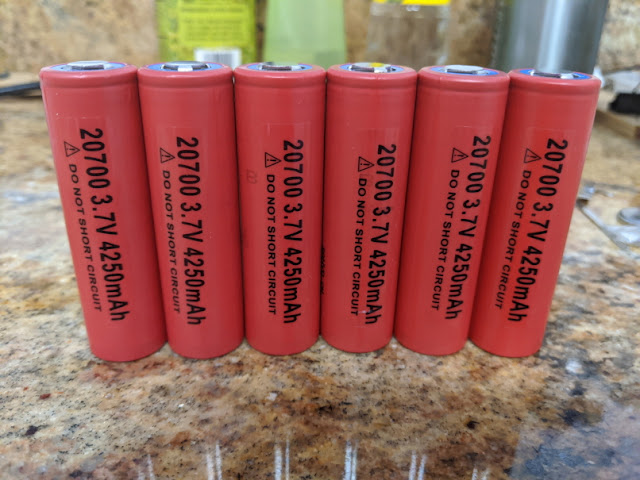
  • Sanyo 20700 x 6
  • 8A PCB and M/F Molex connectors
  • 16AWG stranded wire
  • DC extension cord

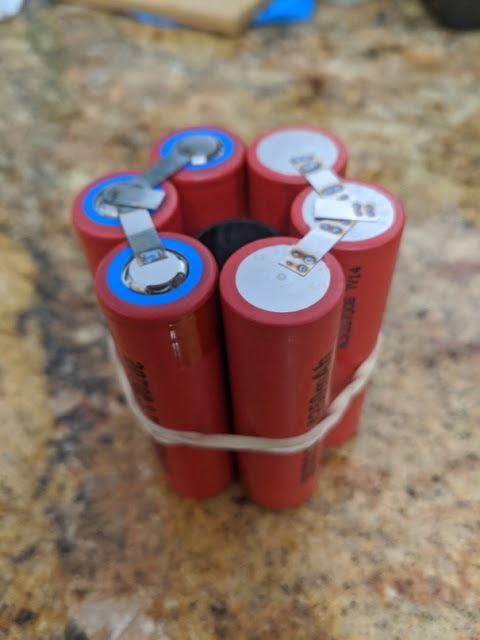
2. Weld taps on cells: for 8.4V output battery pack, three cells are bundled in parallel, and serially connected to another bundle of three parallel cells.


3. At the core, I put a 20mm carbon tube, which helps the pack maintain hexagonal shape. A PCB will be placed within the carbon.


4. Lezyne container will be used for packaging.


5. Plastic sheets for insulation of the battery pack - I picked up the plastic sheet from a recycle bin.


6. Connect PCB and connectors


7. Wrapping


8. Packaging in the Lezyne container.


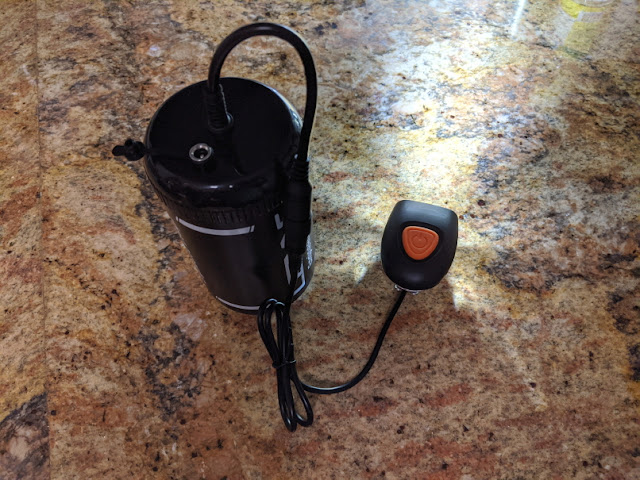
9. Done. Left is the finished work and the right is the original battery pack.


12750mAh, 461g


7800mAh, 336g


Charging


Final test


2019년 12월 15일 일요일

2s Li-ion battery (bicycle light) charger for cars

I made this for charging my bicycle light battery pack in the car.

1. A TP5100 charging module (ebay) has been used


2. Cut the cord and solder the wire on the charger module.


3. Packaging in a plastic enclosure


Because the charging indicator LED would not be seen with the case closed, I drilled a hole on the case lid and plugged a clear acrylic screw.


3. The test was successful and it charged my battery pack like a charm.


2014년 11월 5일 수요일

Reflector + collimator = reflective collimator

It's already more than 10 years ago. One day, I got curious... Collimator lens vs reflector, which one would be better? Regarding this question, I think I am not alone, because I could find some other threads related to the same question.

It was a very hard-to-answer question, so the solution I found was having them together. To this end, a thin layer of aluminum was vapor deposited on the back of collimators. In the next figure, the left hand side is an aluminum deposited collimator, and the right hand side is a normal collimator.


unfortunately, this project was not so successful, because I didn't see any noticeable improvement of brightness even after the aluminum deposition. Maybe, that is because the backside leakage of collimators is quite negligible.

UCO Clarus, my new backpacking gadget!

After getting back from a long hike to Rae Lake Loop, I thought I need a small light weight LED lantern. After some research, I decided to purchase a UCO Clarus lantern, and now I am so happy with that. It just weighs about 2 ounces and super bright. A little downside is that its burn time is less than 2 hours in its high-mode (150lm). However, this is not a downside at all in fact, because it can be easily overcome by using a high capacity Li-ion battery in place of original 3AAA batteries. A 22500 Li-ion battery (2300mAh) nicely fits UCO Clarus as if originally designed for it, and provides about 5 hours' burn in the high-mode - it's more than enough for two days' backpacking trip.


Left - 3AAA, right - 22500 Li-ion
Left - 18500 Li-ion with spacers (18-22 O-rings), right - 22500 Li-ion

2014년 9월 23일 화요일

Got a flashlight finally...

(Re-posted: originally created in July, 2011)

Don't ask why I need a flashlight, because I don't know either. Anyhow, a flashlight is a sort of must have items for men, like a nimble car or zoo annual pass.
Basically, it's a Maglite 2D.


I like Maglites. Most of all, I like the design, which is neat and never outrageous like those of Surefires. I think the halogen lamp is behind the times these days, though. So I threw away the original dim halogen lamp right away after the purchase. Instead, I installed a Terralux LED light source.


 This light source provides 700 lumens, which is 28 times higher than the original halogen. However, it requires supply voltage over 6 volts. Fortunately, I could find this one.


It's a 32600 Li-ion battery, which is of approximately the same size as an Alkaline D cell. It's slightly bigger than the ordinary D-cell in fact. When I first found this battery at an online store, it was out of stock. So, I waited for it to be in stock again for about one good year. With two of these Li-ion cells, I was able to supply 7.4 volts to the light source. Now, the flashlight works perfectly!